 Apache Junction Mobile Home Leveling
 Mobile Home Pier & Pad Repair in Apache Junction
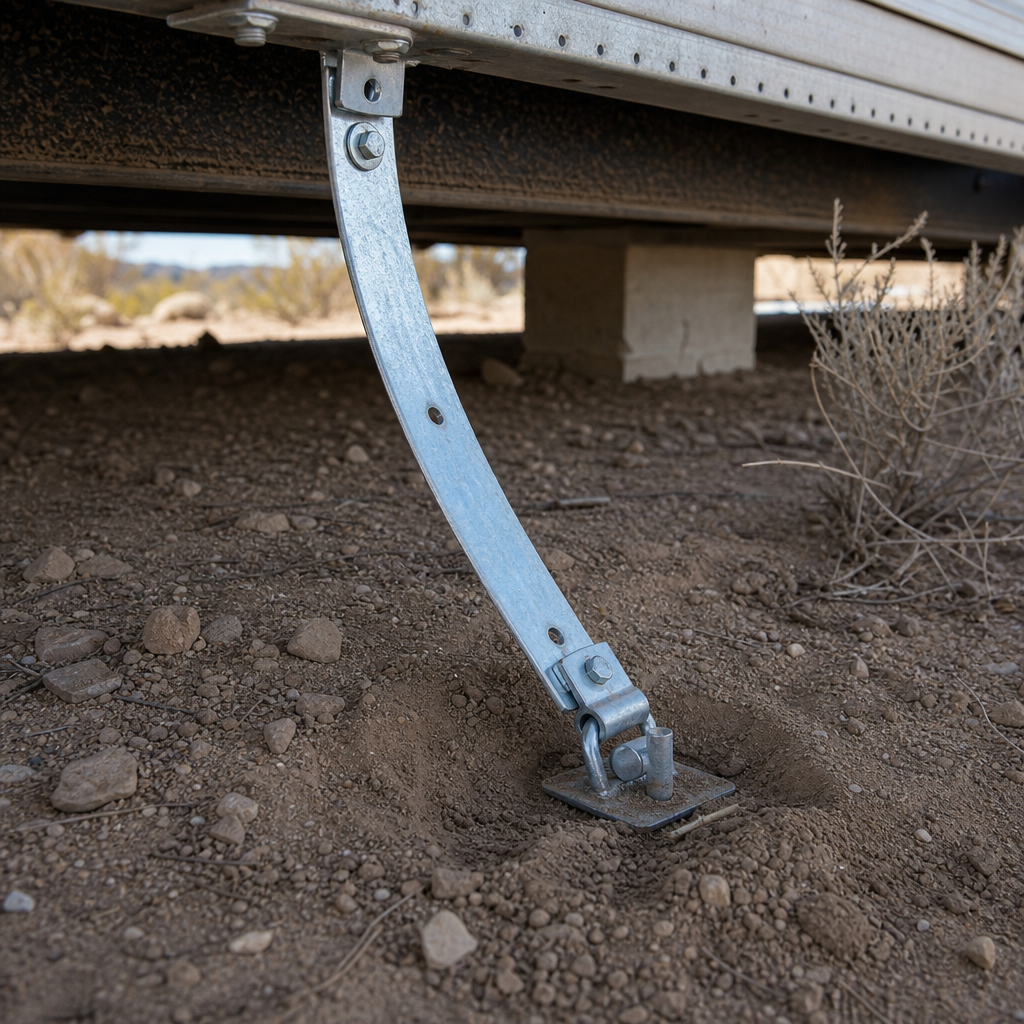
Pier and pad repair rebuilds the support columns under a manufactured home when settling has gone past what shims can correct. Each pier is a stack of concrete blocks on a footing pad, capped and shimmed up to the steel I-beam. When the pad sinks, the blocks crack, the cap crushes, or the shim stack grows past what federal standards allow, the pier gets reset or rebuilt. Resets run $75 to $150 per pier, full rebuilds $150 to $400 per pier, and the free survey prices each one individually across Apache Junction, Gold Canyon, and the East Valley.
This is the work that separates a home that stays level from one that needs a relevel again next year.
What is under a pier here
Desert ground is better footing than most of the country, and it is worth being precise about why, because the exceptions are where the work is.
The USDA soil survey for the east side of the valley maps the fans and terraces between Mesa and the Superstitions as deep, well-drained calcareous loams and gravelly sandy loams. The Laveen association, which the survey says most of Mesa sits on, is lime-rich loam to 60 inches. On the terraces and the fans that run out from the base of the mountains, the Pinal and Cavelt series carry an indurated lime-cemented hardpan at 4 to 20 inches: caliche. A pad that sits on that pan is on something close to soft concrete. Permeability through it is, in the survey’s words, very slow.
The exceptions:
- The loose layer above the pan. Gravelly loam over hardpan is still gravelly loam. A pad that was set 8 inches deep on a lot where the pan is at 18 inches sits on the loose material, and monsoon water pooling on the impermeable pan underneath keeps it soft for days.
- Sandy fans. The Antho soils the survey maps northeast of Mesa, sandy loam to 40 inches or more, are named in the survey as home sites. Sand under a concentrated load compacts and, when water is moving through it, migrates.
- Wash edges. Alluvial land along the drainages is excessively drained very gravelly sand. Anything near Weekes Wash or Siphon Draw sits on material that moves when the wash runs.
- Clay loam subsoils. The Mohall-Contine association covers 29 percent of the survey area. Clay loam swells in a wet winter and shrinks by June, and a pad on it rocks a little with each cycle.
- Fill. Older park lots and a lot of owned-land pads were built up with whatever was handy. Uncompacted fill consolidates for years, and federal standards at 24 CFR 3285.202 require an engineer’s determination when the soil appears to be uncompacted fill for exactly that reason.
Federal standards require the soil bearing capacity to be determined before a foundation is built, and Arizona’s installation FAQ says a penetrometer test is required and must be verified at inspection. That did not happen under most of the 1970s and 1980s stock in the Apache Trail parks. Pier and pad repair is where that gets corrected, one pier at a time.
Reset versus rebuild
Reset or reshim ($75 to $150 per pier). The pier is structurally sound but has dropped a little. The block stack and pad stay; the cap and shims are replaced and driven tight to the beam. This is what most piers on a routine relevel need, and it is included in the relevel price for the piers that only need shimming.
Rebuild ($150 to $400 per pier). The pier comes out and goes back properly:
- The frame is supported on cribbing next to the pier, never on a jack alone.
- The old stack, cap, and pad come out. What turns up under the home tells the story: a pad sunk at an angle into soft ground, a block split from point loading, a cap made of scrap plywood, a shim stack four inches tall.
- The footing gets a proper pad sized to the load and the soil, set on undisturbed or compacted ground. On hardpan lots that can mean cutting down to the pan.
- New 8 by 8 by 16 blocks go up with hollow cells vertical, double-stacked and interlocked when the pier is over 36 inches as 24 CFR 3285.306 requires.
- A solid cap at least 4 inches of concrete or masonry, or 2-inch nominal hardwood, per 24 CFR 3285.304, then paired hardwood shims driven tight within the one-inch allowance.
- The pier is checked under load, and the frame around it is re-shot with the water level.
The difference between the two is not a judgment call. The federal shim allowance decides it: if the pier cannot reach the beam inside one inch of shims plus a 2-inch plate, it is a rebuild.
What the survey finds under East Valley homes
Some patterns repeat under the older stock along US-60, Apache Trail, and Main Street in east Mesa, and in the owned-land homes out toward Queen Valley and Florence:
- Tall shim stacks and plywood caps. The fingerprint of decades of handyman “leveling.” Each fix stacked another layer instead of rebuilding the pier.
- Piers on bare dirt. No pad at all, block sitting on the ground, sunk on one side.
- Sun-dried lumber. Caps and shims that have spent 30 summers over 100 degrees are checked, split, and crumbling. The July normal high at the Apache Junction 5 NE station is 105.2 degrees, and wood under a home does not get shade from a roof so much as heat from it.
- Mismatched marriage-line piers. On doublewides, the center row rebuilt to a different height than the outer rails, so the seam never closes.
- Tall piers on slopes. Gold Canyon and mountain-front lots with 40- and 50-inch piers built as single stacks, which the federal standard does not allow.
Pricing
| Work | Range |
|---|---|
| Reset or reshim, during a relevel | $75 to $150 per pier |
| Full rebuild: pad, blocks, cap, shims | $150 to $400 per pier |
| Typical pier-and-pad job, all in | $500 to $2,500 |
| Relevel of the whole frame, if needed | $450 to $800 single, $750 to $1,400 double |
Rebuild count is what drives the total. A home with three bad piers and a routine relevel lands near the bottom; a home with a dozen piers on failed pads lands near the top. Every pier is priced on the written survey. The pricing page has the full tables.
Licensed work in Arizona
Repairing a home’s foundation system is installation under A.R.S. 41-4001, and installing without an Arizona Department of Housing installer license is an unlawful act under A.R.S. 41-4047. The state’s installation rules at A.A.C. R4-34-802 require the installer to assess the site and soil before setting a home, and to install to the federal standards in 24 CFR 3285 that the state adopted by reference. Whoever quotes your pier work should be able to hand you that license number; check it before they start.
Making it stick
A rebuilt pier on a pad that still floods will settle again. The survey report flags drainage problems along the pier lines: skirting with no vents, a yard that slopes toward the home, a downspout dumping at a corner pier, an old park lot that was never crowned. Fixing the water is what makes the pier repair permanent, and the belly and drainage work often rides along with it.
Request the free survey. We cover Apache Junction, Gold Canyon, east Mesa, and San Tan Valley, and every pier comes back with a number and a reason.
Frequently Asked Questions
What does pier repair cost on a mobile home in Apache Junction?
Resetting or reshimming a pier during a relevel runs $75 to $150 per pier. A full rebuild with new blocks, cap, and footing pad runs $150 to $400 per pier. Most pier-and-pad jobs land between $500 and $2,500 all in, and the free survey prices every pier individually before work starts.
How do I know if my piers need rebuilding rather than reshimming?
Height and condition. Federal installation standards allow no more than one inch of shims plus a limited plate under the beam. A pier that needs more than that to reach the beam gets rebuilt. So does one with a crushed or split cap, a cracked block, or a pad that has tilted or sunk into the ground. The survey documents each pier so you can see which case yours is.
Does caliche mean my piers will never move?
No. Caliche bears well where the pad actually sits on it, but hardpan depth varies from 4 to 20 inches across the fans and terraces here, and many pads sit on the loose gravelly loam above it, or on fill that was never compacted. Monsoon runoff moves that material. A pad on solid hardpan is the best footing in the county; a pad on the loose layer over it is not.
Can piers be repaired without lifting the whole home?
A few piers can be rebuilt one at a time with local lifting, but a home with several low piers is almost always better served by a full relevel so the frame comes back to one plane. Rebuilding one pier to a frame that is still out of level just locks in the tilt. The survey tells us which approach fits.
More mobilehome services
- Mobile Home Leveling & Releveling in Apache Junction
- Mobile Home Tie-Downs & Anchors in Apache Junction
- Vapor Barrier & Belly Board Replacement in Apache Junction
- Mobile Home Skirting Repair in Apache Junction
- Pre-Sale Leveling Inspection in Apache Junction
- Mobile Home Transport & Setup in Apache Junction
- Mobile Home Roof-Over and Roof Coating in Apache Junction