 Apache Junction Mobile Home Leveling
 Mobile Home Tie-Downs & Anchors in Apache Junction
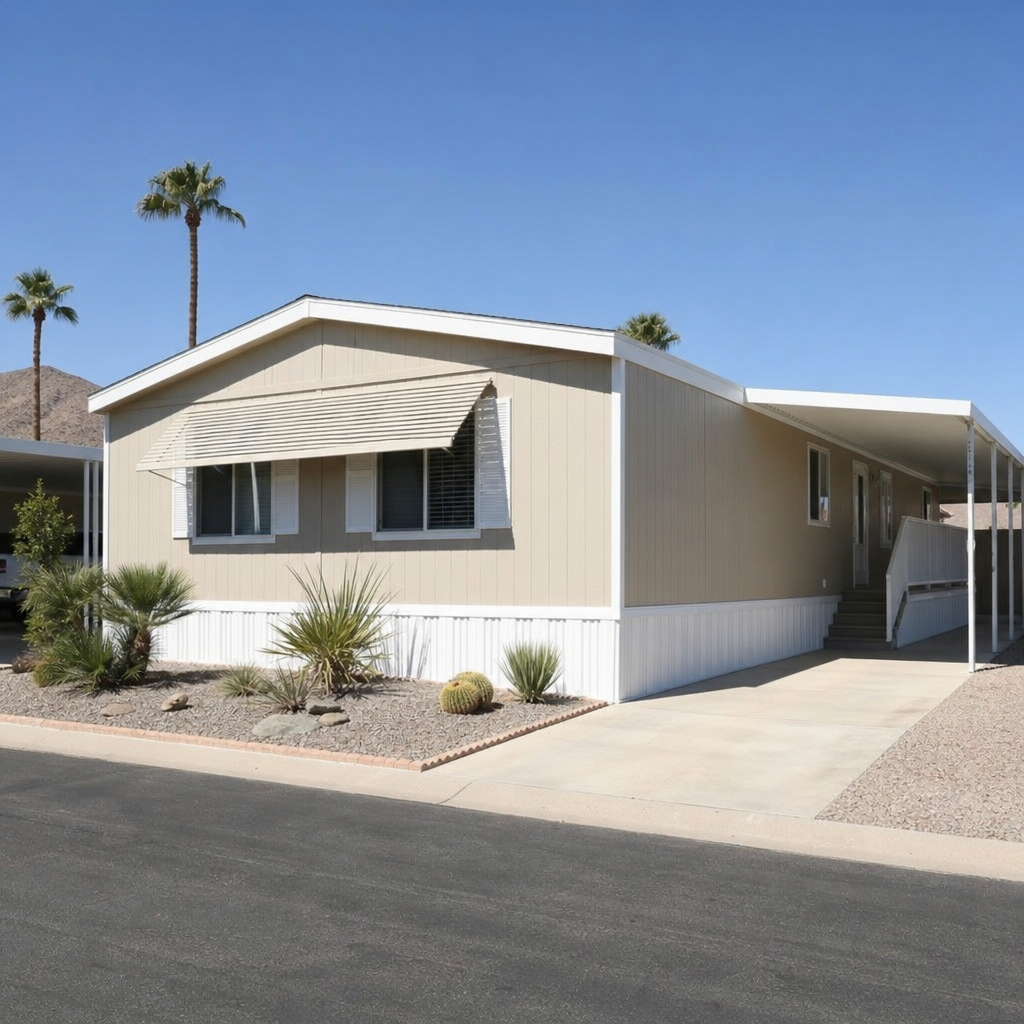
Tie-downs are the ground anchors and steel straps that hold a manufactured home to the earth against wind. Arizona sits entirely in HUD Wind Zone I, and people take that to mean anchors are optional here. They are not. State rules require every mobile home and manufactured home, new or used, to be anchored with an approved system, and the wind that tests that system is the monsoon outflow that hits the East Valley every July and August. Anchor installs and retrofits run $600 to $3,500 across Apache Junction, Gold Canyon, east Mesa, and the rest of the service area, and strap re-tensioning is part of every relevel.
Wind Zone I, and what it does and does not mean
The federal construction standard at 24 CFR 3280.305 divides the country into three wind zones. Zone II, designed against a 100 mph wind, is a named list of coastal counties in Alabama, Florida, Georgia, Louisiana, Maine, Massachusetts, Mississippi, North Carolina, South Carolina, Texas, and Virginia. Zone III, at 110 mph, is Hawaii, coastal Alaska, the island territories, and a few counties in Florida, Louisiana, and North Carolina. Arizona is not on either list, which puts every county in the state in Zone I, where homes are built to a horizontal wind load of 15 pounds per square foot and a net roof uplift of 9. FEMA’s comparison of the HUD zones describes Zone I as roughly a 70 mph design.
That is the home’s structure. The anchoring is separate, and the rules on it do not carve Arizona out:
- The Arizona Department of Housing adopted 24 CFR 3285, the federal Model Manufactured Home Installation Standards, by reference in A.A.C. R4-34-102.
- 24 CFR 3285.402 requires every ground anchor to carry a minimum ultimate load of 4,725 pounds and a working load of 3,150 pounds, requires straps of at least 1 1/4 inch by 0.035 inch steel to the same ratings, and requires the home to be stabilized against wind in the longitudinal direction in all wind zones.
- The Department’s own installation FAQ answers the question directly: all mobile homes and all used and new manufactured homes must be anchored using an approved anchoring system.
- Pinal County’s inspection bulletin for manufactured homes lists a “Support System Tie Downs” inspection, checking that the anchoring system, longitudinal and ground anchor augers, is installed per the manufacturer’s requirements.
Zone I buys you wider anchor spacing than a Gulf Coast home gets. It does not buy you no anchors.
The wind that matters here
Apache Junction does not get hurricanes. It gets microbursts and outflow boundaries, and they are not gentle.
The National Weather Service defines the monsoon as June 15 through September 30. Its monsoon safety guidance sets the severe thunderstorm threshold at 60 mph and notes that the strongest straight-line gusts can exceed 100 mph and do tornado-grade damage. Dust storm warnings go out when gusts of 40 to 60 mph drop visibility to a quarter mile. On August 19, 2026, the Phoenix office documented an outflow boundary that produced a widespread swath of 55 to 65 mph gusts across the metro, dropped visibility below a quarter mile in the East Valley, and took roof sections off a high school in Tempe.
A manufactured home is a light box with a lot of side area, and the mountain-front lots in Gold Canyon and along the Apache Trail get the outflow first as storms roll off the Superstitions. The anchor system is the only thing between that wind and the home walking off its piers.
Why existing systems fail
Under the older park stock along US-60, Apache Trail, and Main Street in east Mesa, and under owned-land homes out toward Queen Valley and Florence, the survey routinely finds:
- No anchors at all. Common under pre-1976 mobile homes and park units set before anyone was inspecting.
- Slack straps. Every time the home settles, the straps go slack. On a home that has not been releveled in a decade, they are decorative.
- Short counts. Four anchors on a 60-foot home. Someone did the corners and called it done.
- Rust and cut straps. Straps cut for a utility repair and never replaced, or corroded where they enter the ground.
- Anchors in the wrong soil. Augers set in the loose gravelly loam above the hardpan, where they never developed the holding capacity the standard assumes.
How an anchor job is done right
1. Soil classification. 24 CFR 3285.202 and 3285.402 require the soil to be classified before anchors are selected, using a torque probe. A reading above 551 inch-pounds is Class 2 soil; 351 to 550 is Class 3; 276 to 350 is Class 4A; 175 to 275 is Class 4B. Anchor length and type follow from the class. Caliche lots read off the top of the scale and usually need pre-drilling; sandy fan lots and wash edges read low and need longer anchors.
2. Layout. Anchor count and spacing come from the home’s installation manual, or from the federal tables when the manual is gone, based on the home’s length, width, and the height the strap attaches at. Vertical and diagonal ties both, plus longitudinal stabilization at the ends.
3. Installation. Anchors set to full depth in the classified soil, straps run from the anchor head to the frame or the sidewall attachment point, tensioned to spec with a proper tensioning tool, and the excess cut and secured.
4. Inspection. On a permitted installation, the county or the state inspects the tie-down system before the home is finaled. On a retrofit under an existing home, you get a written count and a diagram.
Pricing
| Job | Range |
|---|---|
| Strap re-tension | bundled with a relevel |
| Replace cut or corroded straps | quoted per strap after survey |
| Full install or retrofit, singlewide | $600 to $1,800 |
| Full install or retrofit, doublewide | $1,500 to $3,500 |
| Hardpan pre-drilling | quoted per anchor |
What moves the number is the anchor count and the ground. A short singlewide on Class 3 soil is a quick job. A 70-foot doublewide on shallow caliche with every anchor pre-drilled is a long one. The survey is free and the number is written before anyone drills. Full tables are on the pricing page.
Licensed anchor work
Arizona defines installation to include providing ground anchoring for a home or repairing it (A.R.S. 41-4001), and the Department of Housing’s I-10C general installer classification specifically covers ground anchors and tie-downs. Engaging in that work without an installer license is an unlawful act under A.R.S. 41-4047. So before anyone touches your anchors, ask for that installer license and look it up.
Note that Apache Junction’s own code defines a permanent foundation as one that is not affixed with straps to ground anchors other than footings. A home on an engineered permanent foundation is anchored through the foundation itself, and that is a different job, handled with the transport and setup work.
Buying a home on a stem wall: tie-downs, the plaque, and what to ask
A stem wall does not take a home out of the anchoring rule. The Arizona Department of Housing’s installation FAQ says all mobile homes and all new and used manufactured homes must be anchored with an approved anchoring system. The federal standard allows two ways to meet that: 24 CFR 3285.401 says that after blocking and leveling, the home must be secured against wind either by anchor assemblies or by connecting it to an alternative foundation system, and it allows the foundation and anchorage to be designed by a professional engineer or registered architect. So a home on a stem wall may have no straps running to ground anchors and still be anchored, through the connection between the frame and the wall. What a buyer needs to confirm is that the connection exists and was inspected.
The plaque on the end of the house. That is most likely the HUD certification label. Under 24 CFR 3280.11 it is a metal plate of roughly 2 by 4 inches, riveted or screwed to the taillight end of each transportable section about a foot up from the floor, so a doublewide has two. It carries the manufacturer’s certification that the section was built to the federal construction and safety standards, a three-letter code for the inspection agency, and a six-digit number.
The data plate is a different thing, and it is inside. 24 CFR 3280.5 puts it near the main electrical panel or another readily accessible spot, and HUD says to look in a kitchen cabinet, the electrical panel, or a bedroom closet. It lists the plant, serial number, model and date of manufacture, the label number for each section, and the roof load and wind zone the home was built for. Check that the label numbers on it match the plates outside.
If a plate is missing. HUD does not reissue certification labels. It can issue a Letter of Label Verification, requested through the Institute for Building Technology and Safety (IBTS), when the historical record can be found. Sort that out before closing, not after.
What to ask for before you buy. Arizona requires a permit to install a manufactured home and a certificate of occupancy from the Department of Housing before anyone occupies it (A.A.C. R4-34-801). Ask the seller for the installation permit, the final inspection, and the certificate of occupancy. If the paperwork is gone, ask the Department’s Office of Manufactured Housing or Apache Junction Building Safety what is on file for the address. Then have the underside looked at before you sign: a pre-sale inspection from us checks level, blocking, and anchoring. We will point out exactly where the frame is tied to the stem wall.
Before the season
The right time to find out what is under the skirting is May, before the first outflow, or October, when snowbirds get back and the home has sat through a summer of storms unattended. A pre-sale inspection covers the same ground for anyone buying. Request a free survey; the service covers Apache Junction, Gold Canyon, east Mesa, and San Tan Valley.
Frequently Asked Questions
Does a mobile home in Arizona have to be anchored?
Yes. Arizona is in HUD Wind Zone I, the lowest of the three federal zones, but the Arizona Department of Housing's installation FAQ states plainly that all mobile homes and all new and used manufactured homes must be anchored with an approved anchoring system. The state adopted the federal installation standards in 24 CFR 3285 by reference, and Pinal County inspects the tie-down system on every permitted installation.
The home I want to buy sits on a stem wall. Does it still need tie-downs?
It still has to be anchored: the Department of Housing's rule covers all mobile homes and all new and used manufactured homes, whatever they sit on. On a stem wall or other permanent foundation the anchoring is normally part of the foundation design, with the frame connected to the wall or footing, instead of straps running to ground anchors, so you may see no straps at all and still be fine. What a buyer needs is proof the connection exists: ask the seller for the installation permit and final inspection from the Department of Housing or the city, and have the underside looked at in a pre-sale inspection before you close.
What does tie-down work cost in Apache Junction?
A full anchor and strap install or retrofit runs $600 to $3,500 depending on the home's length, how many anchors the layout calls for, and whether hardpan has to be drilled to set them. Re-tensioning existing straps is bundled with every relevel. The free survey counts the anchors you have, checks each strap, and prices what is missing.
How strong do the winds actually get here?
The National Weather Service issues a severe thunderstorm warning at 60 mph, and its monsoon safety guidance notes the strongest straight-line gusts can exceed 100 mph. On August 19, 2026, an outflow boundary produced a swath of 55 to 65 mph gusts across the Phoenix metro with roof damage in the East Valley. That is the wind an anchor system here is for, and it arrives every summer.
Can auger anchors be installed in caliche?
Not by turning them in. Where the lime-cemented hardpan is shallow, we pre-drill through it or use an alternative anchor the manufacturer's instructions or an engineer allows. Federal standards require the soil to be classified with a torque probe before anchors are chosen, and hardpan is exactly the case where that step matters.
More mobilehome services
- Mobile Home Leveling & Releveling in Apache Junction
- Mobile Home Pier & Pad Repair in Apache Junction
- Vapor Barrier & Belly Board Replacement in Apache Junction
- Mobile Home Skirting Repair in Apache Junction
- Pre-Sale Leveling Inspection in Apache Junction
- Mobile Home Transport & Setup in Apache Junction
- Mobile Home Roof-Over and Roof Coating in Apache Junction